

Executive Roadshows Require More Than a Car
MULTIPLE STOPS. ONE MANAGED TRANSPORTATION PROGRAM.
Executive Roadshows Require More Than a Car
MULTIPLE STOPS. ONE MANAGED TRANSPORTATION PROGRAM.




A roadshow is one of the most schedule-sensitive forms of executive travel. The itinerary is compressed, the audience is important, and each movement has to support the next commitment.
Executives may move through offices, hotels, airports, FBOs, venues, restaurants, and multiple cities in a single day or across several consecutive days. Each transfer has to be planned around timing, access, communication, and the consequences of delay.
Boston Corporate Coach™ provides multi-city roadshow ground transportation for executives, investor relations teams, financial services firms, private equity groups, banking and advisory teams, corporate leadership, board members, media teams, and event planners who need each movement planned, monitored, and adjusted in real time.
This is not simply hourly car service. It’s transportation logistics for business-critical travel.
When the roadshow is structured correctly, a traveler does not think about the car. The executive assistant, travel manager, investor relations coordinator, or event planner does not chase the chauffeur. The schedule does not fall apart because one meeting runs long or one airport transfer changes.
The traveler should not have to think about the vehicle, and the people managing the program should not have to chase status updates. The transportation should support the schedule from the first pickup through the final movement.
What Is Roadshow Ground Transportation?
Roadshow transportation is a managed executive ground transportation program built around multiple appointments, destinations, and schedule changes.
A typical roadshow may include:
- airport or FBO transfers
- analyst meetings
- banking and advisory team schedules
- board presentations
- capital-markets presentations
- client presentations
- conference schedules
- due-diligence programs
- earnings-related investor meetings
- executive briefings
- fundraising meetings
- hospitality events
- investor days
- IPO roadshows
- media appearances
- multi-city travel over several days
- non-deal roadshows
- private equity fundraising
- product launches
- site-visit programs
The work is not just moving a passenger from one address to another. The work is protecting the schedule.

A strong roadshow transportation program accounts for pickup windows, meeting length, traffic patterns, building access, passenger preferences, vehicle staging, alternate routes, waiting time, chauffeur communication, airport timing, and what happens when the schedule changes.
Boston Corporate Coach™ manages roadshows through centralized coordination, professional chauffeurs, transportation manifests, live dispatch oversight, and a fleet capable of supporting individual executives, small teams, and even larger groups.
Levels of Roadshow Transportation Support
Roadshow transportation can be structured at different levels depending on the itinerary, number of travelers, and complexity of the program. Boston Corporate Coach™ can support:
Built for Executive Assistants, Travel Managers, and Investor Relations Teams
Roadshows are often managed by the people who have the most responsibility and the least margin for error.
- Executive assistants need to know where the principal is, when the vehicle is staged, who the chauffeur is, and whether the next stop is still on time.
- Corporate travel managers need consistency across markets, centralized billing, reliable communication, and a provider that can support duty-of-care expectations.
- Investor relations teams need transportation that protects presentation schedules and allows executives to stay focused between meetings.
- Event planners need vehicle assignments, arrival sequencing, and passenger movement coordinated across venues.
- Flight departments need ground transportation aligned with commercial flights, private aircraft, FBO procedures, and tail-specific timing.
Boston Corporate Coach™ supports each of those stakeholders with a roadshow transportation model designed around visibility, communication, and operational control.
Roadshow Transportation Is a Managed Program
A roadshow should be managed as one transportation program, not as a series of unrelated reservations. When meetings, airport transfers, hotel pickups, and evening movements are booked separately, visibility is lost and the burden shifts back to the assistant, travel manager, or investor relations coordinator.
Boston Corporate Coach™ structures roadshow transportation as a program.
That means the full itinerary is reviewed before service begins. Pickup times, meeting locations, stop sequences, vehicle classes, passenger names, chauffeur assignments, and timing assumptions are organized into a working transportation plan.
The goal is to know the roadshow front-to-back before the first vehicle ever leaves the garage.
What a Roadshow Transportation Program Can Include
| Roadshow Element | Why It Matters |
|---|---|
| Dedicated point of contact | Gives the assistant, travel manager, or event coordinator one place to manage the program. |
| Transportation manifest | COrganizes pickup times, addresses, stops, vehicles, chauffeurs, passengers, and timing notes. |
| Route planning | Accounts for drive time, traffic, building access, event congestion, and buffer time. |
| Vehicle sequencing | Ensures the right vehicle is assigned to the right traveler, meeting, or group movement. |
| Live dispatch oversight | Keeps the trip visible while the schedule is active. |
| Commercial flight tracking | Supports airport arrivals, delays, diversions, and revised flight timing. |
| FBO coordination | Aligns ground transportation with private aircraft movements and FBO procedures. |
| Schedule change support | Allows the roadshow to adapt when meetings run long or new stops are added. |
| Multi-city coordination | Supports roadshows across several markets through one operating structure.onsolidates trips, vehicles, markets, and program days for cleaner reconciliation. |

Dedicated Roadshow Coordinators
For more complex roadshows, Boston Corporate Coach™ can assign a dedicated roadshow coordinator to help keep the transportation program organized from planning through completion. The coordinator reviews the itinerary, confirms pickup locations, validates timing assumptions, organizes vehicle assignments, and helps identify potential gaps before the first vehicle is dispatched.
During the program, the coordinator can remain the primary point of contact for the executive assistant, travel manager, investor relations coordinator, event planner, or on-site lead. That role helps manage transportation manifests, communicate schedule changes, coordinate with dispatch, and keep stakeholders aligned as the roadshow moves.
Pre-Program Planning and Itinerary Review
Roadshow transportation should not begin with simply accepting a list of stops. Before service begins, Boston Corporate Coach™ can review the itinerary for transportation risks, including:
- unrealistic drive times
- insufficient buffers
- building-access issues
- airport timing conflicts
- FBO procedures
- vehicle-capacity concerns
- luggage requirements
- schedule compression
That planning helps identify issues before the traveler is in motion. A strong roadshow plan does not eliminate every variable, but it does give the operations team, chauffeur, and client contact a clearer structure for managing the day.
The Invisible Work Behind a Smooth Roadshow
To a passenger, a successful roadshow feels simple.
The chauffeur is there. The vehicle is clean. The next address is known. The traveler can prepare, take calls, review notes, or decompress between meetings.
Behind that simplicity is the work that protects the schedule.
Boston Corporate Coach™ reviews the itinerary, assigns the appropriate vehicle, briefs the chauffeur, monitors traffic, tracks flight changes, documents stops and waiting time, and keeps the operations team aware of trip status.
The best work is often invisible. A passenger does not see the issue that was prevented. They only experience the result: the roadshow stays on schedule.
That is the difference between ordering a car and managing executive transportation.
Vehicle Options for Roadshow Transportation
Different roadshows require different vehicles. A solo CEO does not need the same transportation plan as an investor relations team, product launch group, or full executive delegation.
Boston Corporate Coach™ offers a full executive fleet that can be matched to the itinerary.

- Executive Sedans. Best for individual executives, board members, investors, and VIP travelers who need quiet, discreet transportation between meetings.
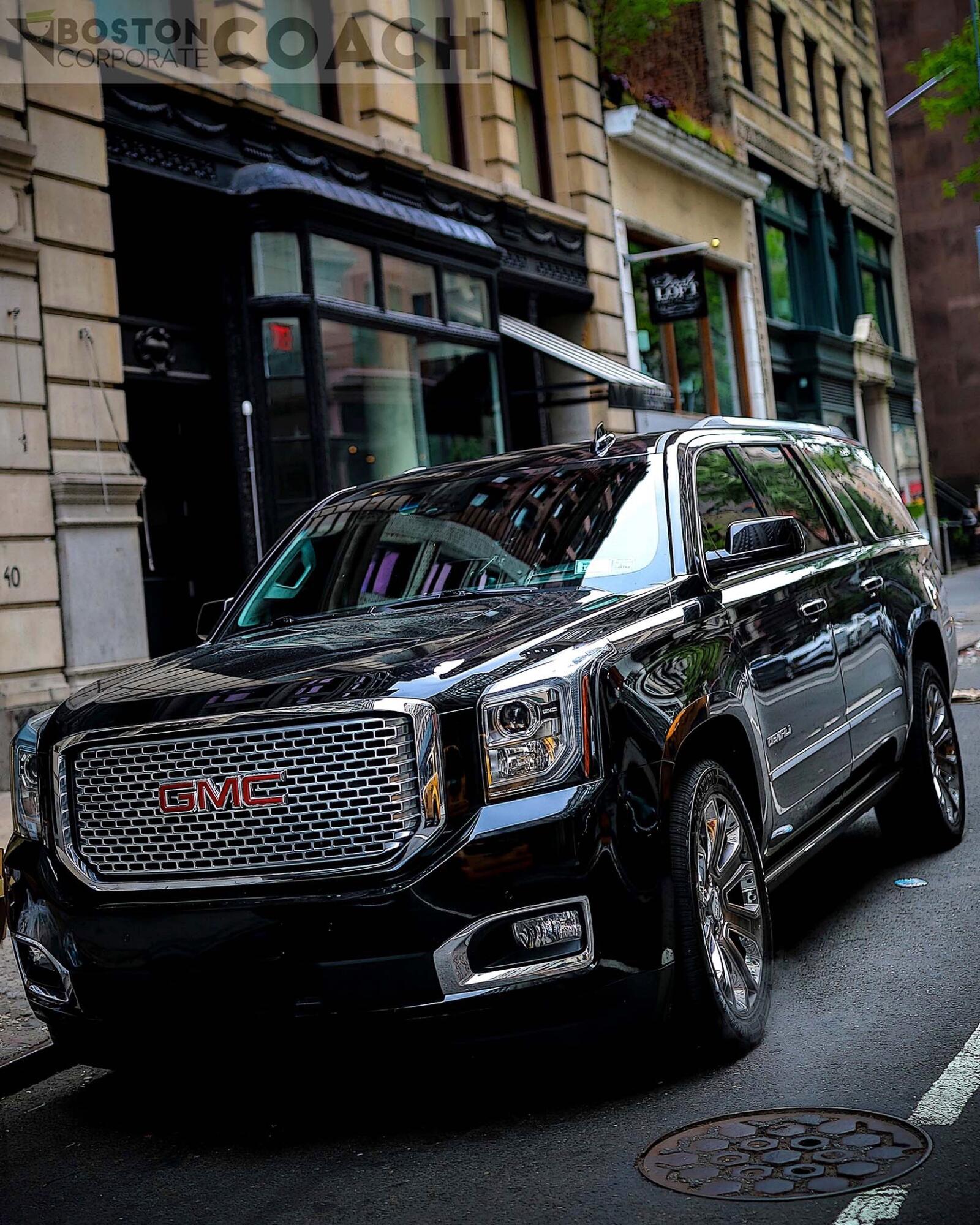
- Luxury SUVs. Best for executives traveling with colleagues, assistants, security personnel, luggage, presentation materials, or personal items. SUVs provide additional space without sacrificing privacy or professional presentation.
- Executive Sprinter Vans. Best for small roadshow teams, investor relations groups, product teams, crew transfers, or multi-passenger programs requiring one coordinated vehicle.
- Mid-Size Coaches. Best for larger corporate teams, conference roadshows, hosted groups, and multi-stop programs where a sedan or SUV is not enough.
- Motor Coaches. Best for large-scale programs, conventions, investor days, executive briefings, sponsor groups, and multi-city movements where passenger count, luggage, and schedule complexity require coach-level planning.
Multi-City Roadshow Coordination
A single-city roadshow is already complex. A multi-city roadshow adds layers of airport timing, FBO coordination, hotel movement, market-specific traffic, vehicle availability, and communication across consecutive travel days.
The schedule may include Boston in the morning, Philadelphia in the evening, Chicago the next day, and London later in the week. The traveler may be using commercial flights, private aviation, train service, or a mix of all three. Meetings may be spread across financial districts, hotel conference rooms, company headquarters, private clubs, restaurants, airports, and FBOs.
Boston Corporate Coach™ supports multi-city roadshows through a centralized operating model across 680+ cities in 27+ countries.
That means a client does not need to rebuild the transportation plan from scratch in each market. The same reservation team, dispatch structure, service expectations, and account oversight can follow the roadshow across cities.
For executive assistants and travel managers, this reduces the burden of managing multiple local vendors. For travelers, it creates a more consistent experience from market to market.
Airport and FBO Integration
Roadshows often begin or end at the airport.
A traveler may land in Boston, attend three meetings, fly private to Teterboro, meet investors in Manhattan, then continue to another market that evening. If the ground side is not coordinated with the air side, the entire schedule can start to slip.
Boston Corporate Coach™ supports roadshow airport coordination with:
- commercial flight tracking
- airport meet-and-greet service
- flight delay monitoring
- diversion communication
- FBO coordination
- private aviation timing
- tail-specific staging where permitted, available, and arranged in advance
- passenger and luggage support
- transfers between airports, hotels, offices, and venues

For commercial flights, the operation is flight-driven. For private aviation, the movement is often instruction-driven: if the flight department requests the vehicle staged at a specific time, the chauffeur is positioned according to that instruction.
Roadshow transportation works best when air and ground are managed as one connected itinerary.

Live Dispatch and Schedule Change Management
Roadshows can change for any number of very valid reasons:
- meetings running long
- lunch moving to a different location
- the principal stopping at the hotel
- a new investor meeting being added
- traffic conditions changing
- weather affecting the route
- a building’s loading zone becoming unavailable
- a flight being delayed
That is why Boston Corporate Coach™ does not treat dispatch as a passive function.
The dispatch team monitors active trips, chauffeur status, schedule notes, traffic conditions, and route changes. Chauffeurs use trip status tools to document arrival, passenger on board, waiting, circling, stops, and drop-off. If a passenger changes the scope of service during the roadshow, those changes can be documented and communicated back to the operations team. That documentation keeps the roadshow visible to the operations team and gives executive assistants, travel managers, and investor relations coordinators clearer answers when schedules shift.
It also gives executive assistants and travel managers a clearer answer when they ask, “Where is the car?” or “Can we still make the next meeting?”
Roadshow Communication Protocols
Roadshow communication should be structured around the client’s preferred chain of command. Some programs route updates to an executive assistant. Others require communication with an investor relations coordinator, travel manager, security contact, on-site lead, or event planner.
Boston Corporate Coach™ can align communication preferences before the program begins, including who receives chauffeur details, who receives schedule-change updates, who approves itinerary adjustments, and who should be contacted if timing, routing, airport activity, or passenger movement changes.
The goal is to keep the right stakeholders informed without sending unnecessary updates to every person involved in the program.
15 Minutes Early Is the Standard
For non-airport pickups, Boston Corporate Coach™ expects chauffeurs to arrive 15 minutes before the scheduled pickup time.
For roadshows, that early arrival standard matters because a pickup cannot begin with the chauffeur still approaching the address.
A 9:00 a.m. pickup cannot start with the chauffeur arriving at 9:00 a.m. The vehicle needs to be in position, the address confirmed, building access understood, and the chauffeur ready before the traveler steps outside.
That early-arrival standard helps absorb the small frictions that can derail a day, such as: a busy curb, a security desk delay, a police officer moving traffic, an executive running early, or a building with multiple entrances.
For roadshows, the vehicle should be staged before the scheduled pickup time, not simply arriving at that time.
Roadshow Reliability and Backup Planning
Boston Corporate Coach™ tracks on-time performance and has reported 99.7% year-to-date on-time performance.
That level of reliability is the result of structure, planning, and live operational oversight.
Every trip has a backup plan. That may involve alternate vehicles, replacement chauffeurs, affiliate support, dispatch escalation, or route adjustments. A client may never see that work, and in a successful program, they shouldn’t have to.
Traffic, flight delays, vehicle issues, road closures, and schedule changes can happen during any complex travel program. The difference is how quickly the provider identifies the issue, communicates clearly, and resolves it before it affects the traveler.
That is where Boston Corporate Coach™ is strongest.
Pricing for Multi-City Roadshow Transportation
Roadshow pricing depends on the service structure.
Some simple movements may be priced as point-to-point transfers. Most roadshows, however, involve hourly or garage-to-garage service because the chauffeur and vehicle are committed to a client for a block of time.
That’s an important distinction.
In a roadshow, the client isn’t paying for the minutes the passenger is physically in the vehicle. The client is reserving a dedicated chauffeur and vehicle that must remain available between stops, wait during meetings, reposition as needed, and continue with the schedule as it changes.
To that end, pricing may be affected by:
- vehicle type
- number of passengers
- number of stops
- total service time
- garage-to-garage time
- city or market
- airport or FBO activity
- last-minute itinerary changes
- special events or peak demand
- parking, tolls, and access fees
- multi-day or multi-city complexity
Roadshow transportation is priced according to the dedicated resources, planning, and live operational support required to protect the schedule. The price reflects the operational commitment behind the program, including chauffeur and vehicle availability, wait time, dispatch oversight, route planning, schedule-change support, and the ability to keep the roadshow moving as one coordinated assignment.
Common Roadshow Use Cases
Why Not Use Rideshare or Separate Local Cars?
Rideshare and one-off local car bookings may work for simple personal travel, but they are not structured for executive roadshows.
The risks are obvious:
- inconsistent vehicle quality
- inconsistent driver professionalism
- no single point of coordination
- no full-day schedule visibility
- no transportation manifest
- no executive assistant support
- no proactive route or timing oversight
- limited duty-of-care visibility
- no coordinated backup planning
- no centralized billing across the program
With a roadshow, the value is not simply having a car arrive. The value is that the transportation program is managed as one continuous assignment.
Boston Corporate Coach™ gives every client one coordinated structure instead of a collection of disconnected rides.
What to Provide Before Booking a Roadshow
The more complete the itinerary, the more effectively Boston Corporate Coach™ can identify timing risks, vehicle requirements, access issues, and communication needs before the program begins.
To make the booking process as smooth as possible, please be ready to provide:
- traveler names
- passenger count
- luggage count
- preferred vehicle type
- pickup and drop-off addresses
- meeting times and expected duration
- building entrance or loading dock details
- airport or FBO information
- flight numbers or tail numbers
- hotel details
- security or privacy requirements
- billing contact
- on-site coordinator contact
- communication preferences
- whether the vehicle should remain with the traveler between stops
The roadshow can still change, of course. But the stronger the starting plan, the easier it is to adapt without losing control.
Roadshow Transportation for Global Corporate Travel Programs
For global organizations, roadshow transportation is often part of a larger managed travel program. Boston Corporate Coach™ supports recurring roadshows, investor meetings, board programs, funding rounds, leadership tours, and sponsor events with stored traveler profiles, centralized billing, itemized reporting, account oversight, and service consistency across markets.
For executive assistants and travel managers, that creates continuity. Preferences are known, contacts are established, billing is consolidated, and the transportation partner becomes an extension of the travel operation rather than another vendor to manage.



Plan a Roadshow That Runs on Time
Roadshow transportation is not about luxury for its own sake. Luxury is expected. Reliability, coordination, and schedule protection are the real product.
Boston Corporate Coach™ provides multi-city roadshow ground transportation for clients who need their executives and teams to move with confidence. From airport arrival through the final meeting of the day, the program is built around timing, discretion, communication, and operational control.
Reserve Online or call 800-664-4480 to speak with a specialist today.
Boston Corporate Coach™ delivers luxury chauffeur services supported by established service standards, professional operations, and responsive client support. Our services are designed to meet the expectations of corporate leaders, executive assistants, and global organizations that require reliability, discretion, and consistency.